Interview: Mohammed Alshaali for Gulf Craft
It is remarkable that Mohammed Alshaali ever had time to start a yacht building business, but heart and enthusiasm are more than enough to get things moving.

“If you don’t wake up at six o’clock in the morning thinking about boats, then you shouldn’t be in this business.” For Mohammed Hussein Alshaali, Chairman of Gulf Craft, the emotional involvement goes back a very long way. When he says, “I was born on the beach” it is not a throwaway line. Alshaali’s father was a sea captain in the days when fishing and pearling were the staple maritime trades in what were then called the Trucial States – a British Protectorate that became the United Arab Emirates in 1971. “My father made trading voyages all the way to East Africa, and I was brought up on tales of seafaring and the challenges of the sea,” he reflects, “and these became deeply ingrained in my memory.” There really is salt water in his veins.

The Gulf Craft Head Office
Early experiences of boat building were strictly experimental – young boys messing about with boats. A fuel tank ‘glued’ together with tar was not something to be repeated. “The boat sank anyway, but fortunately we could swim.” Alshaali survived long enough to collect a degree in Management and Economy from Beirut Arab University and then joined the UAE Foreign Ministry, where a distinguished career took him to Ambassadorships in Washington and at the UN in New York and Geneva. But that’s nothing do with building boats… “All my free time, I always went back to the water. I love fishing. I bought a small boat, a Wellcraft, and shipped it from the US to Dubai… and a year later I bought another one, just 2ft longer. Then my brother and I wondered why we were spending so much money shipping boats, and why didn’t we build them ourselves? And that’s how Gulf Craft was born, in 1982.” (For the record, the company is presently ranked 10th in the 2014 Global Order Book of Superyacht Shipyards).
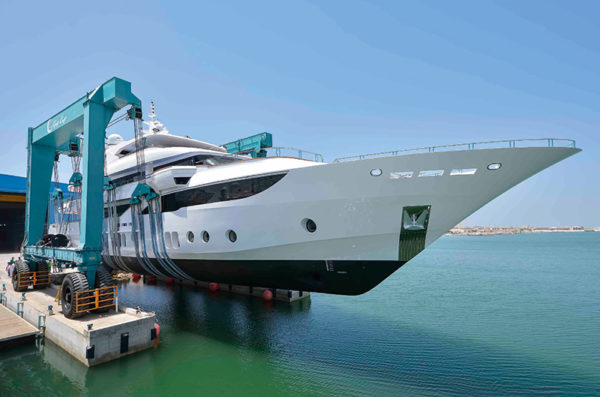
The Gulf Craft’s largest manufactured Superyacht, Majesty 155 being launched
“We used our capital to buy expertise. We bought moulds from the US, but the design was for a lake boat which was unsuitable for the local conditions, so we went back and redesigned… it was a very steep learning curve, and it was a very hectic time,” says Alshaali, but with a smile that says it was also exciting and hugely enjoyable. “We learned a lot during those first 10 years.” The first proper production boat out of the yard was a Colvic 53 designed by John Bennett, and in 1996 Gulf Craft invited Massimo Gregory to design a 77’ motoryacht that gradually expanded itself in an 82-footer. “We sold the first one to the President of the UAE, Sheikh Zayed bin Nahyyan.”
Over the years, many notable names have been involved with Gulf Craft – Frank Mulder and Evan Marshall to name but two. Alshaali thinks for a moment. “We always had the passion, and that was natural, but passion and ambition have to be tempered by ability. This is very important. You really can’t start building 100ft+ superyachts on day one. There is a sort of apprenticeship that you have to go through. A 100ft boat is not simply two 50-footers end-to-end together. It’s going to be almost ten times the volume, and a hundred times more complicated. At each stage of our growth we have been successful because we always ‘listened’ to our ability and kept an eye on the quality.”
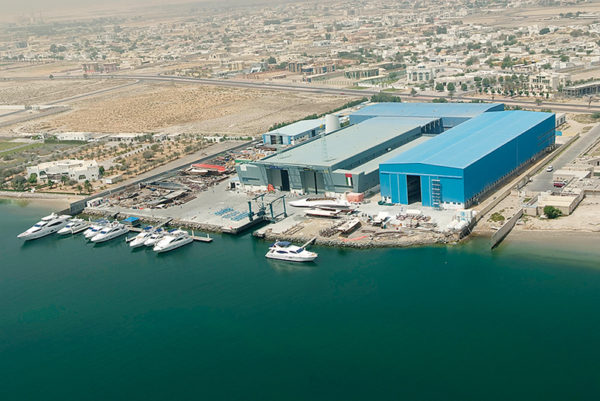
Majesty Yachts shipyard
In 1993 Gulf Craft yachts started appearing in Asia – principally Malaysia and Thailand – and in 2001 the company introduced the Majesty Yachts series, starting with the 66’ and then the 77’. These were aimed squarely at the US market and went on display at the Fort Lauderdale Boat Show, but the market for a Middle East-built boat was never going to be good in the aftermath of 9/11.
So Gulf Craft went back to building smaller boats, and then gradually expanded all over again. Top of the range are presently the Majesty 125 and Majesty 135 tri-deckers, with a 155 due to be launched in Umm Al Quwain in June this year. “The market has shifted in recent years,” reports Alshaali, “and we are now selling almost 40% of our production straight into the Middle East. We are positioned in a very strategic location – close to the traditional yacht markets of Europe, and on the edge of a fast-developing Asia. It’s a good place to be.” Along the way Gulf Craft have been obliged to develop a super-efficient production supply chain. “We source components from all over the world, and what we can’t find easily and at a good price, we make ourselves. This forces us to produce our yachts in a timely manner and in an economical way. We can’t just go down the road to the chandlery for a different size shackle because we have changed our mind… It encourages attention to detail in the process, and efficient production planning.”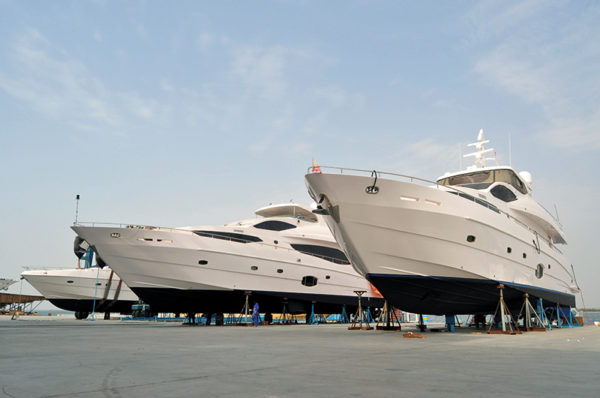
After 32 years of operation, Gulf Craft has staff that have been with the company since the start. Alshaali is proud of that. “Experience is probably more valuable than anything else I can think of. You also need stability in this business: yacht building is a high-value low-units business. It doesn’t work on quarterly returns. Before the global financial crisis there were five very good years of business, but still some builders were saddled with huge and unrealistic debt. If you are not making money in the good times, how can you survive in the lean times?”

Mohammed Hussein Al Shaali, Chairman of Gulf Craft and Erwin Bamos, CEO of Gulf Craft, at the opening of the Singapore Yacht Show
Mohammed Alshaali has now forsaken the Diplomatic receptions to concentrate on building boats. He still loves to fish, and is able to do so in rather more luxury than he did 30 years ago. And he still wakes up at six o’clock in the morning thinking about building boats.
Story Credits
Text and portrait by Guy Nowell, Editor-at-Large, Yacht Style
This story first appeared in Yacht Style.