Longines CEO Matthias Breschan on Future Challenges
Longines CEO Matthias Breschan appears positively prescient about future challenges through this interview
In January this year, consulting group McKinsey and fashion trade specialist platform Business of Fashion released a report that claimed that “the luxury industry is at a critical juncture.” Although somewhat overshadowed due to recent events (see below), the report focused on the problem of value creation, or the perceived lack thereof, in the luxury industry, including watchmaking.
The report concluded that visionary leadership and a commitment to long-term results (which by definition requires vision) were crucial to the overall health of any given luxury brand. If you know anything about Longines CEO Matthias Breschan, you might have had his approach in mind, if you read this report. Yes, even considering the chaos that has enveloped the global economy recently.
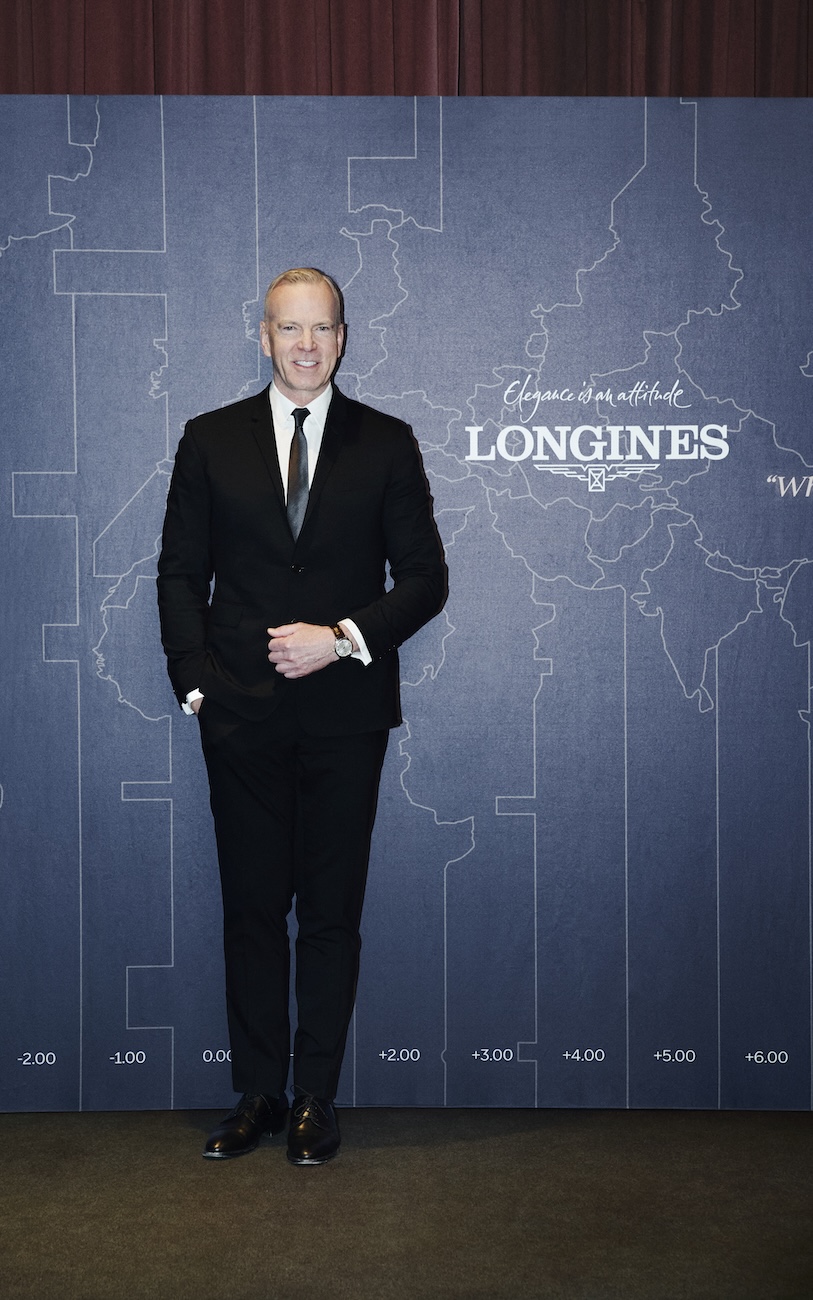
Presenting his plan for Longines on stage in Seoul South Korea in early March to a group of select regional and local press, Breschan is the very picture of confidence. For several years now, he has leveraged his air of almost easy-going assurance to remind partners and the press that Longines is charting quite a different course to many Swiss counterparts, including those within the Swatch Group, which owns the brand.
Breschan is well known in the trade, having taken the helm of Longines in 2020 as the industry was facing uncertain times. Unfortunately, Breschan will need to draw on his reserves of calm positivity to face down yet another challenge.
Of course, Breschan could not have known at that time of the coming tariff wars that have sapped confidence in the global economy and upended the rules-based order of contemporary trade. No one could have. Nevertheless, he understands the importance of confidence and the role it plays in getting people to spend on luxury goods. Of course, no one brand or industry can deliver this but a watchmaker such as Longines can at least be confident in its approach to making watches that its customers want.
When asked about whether Longines had the right watches for now and the foreseeable future, Breschan was clear that he thought so. To be clear, we asked him if challenges for Longines included anything on the product front, from sizes to the nature of the assortment, from the gender split of the customers to the push-pull between vintage and contemporary design preferences. His answer, in one word, was no. If that is not the very picture of confidence, we do not know what is.
Bear in mind that the following interview was conducted before the US tariffs announcement and before the broader watch world gathered for the big show in Geneva.
Tell us about the state of the market, as you see it.
Well, 2024 was definitely a challenging one for the market, not only for the watch industry, but for the luxury industry as a whole, and consumer goods in general. But when you look into the details (for Longines), it’s really limited to a specific region where we really had a difficult environment.
That was China, Hong Kong and Macau. If you take those three areas out, our results in 2024 were even with 2023. So, the situation in Europe, the USA, Canada, Latin America, the Middle East and also other Southeast Asian countries have was extremely good. Korea and Japan were also very good. Basically, the rest of the world (having said that) China, Hong Kong and Macau are very important and very big for Longines and that was a problem for us.
I think people in those markets were confronted with an economic situation that was new to them (higher than normal unemployment, and youth unemployment). There has been corrective action taken by (governments in the Greater China region) and we are (thus) very positive. Already in the second half of this year, you will the results. So, we actually count on strong growth in the second half of 2025 and then I think this region will be back to normal. But the biggest problem last year was definitely limited to this region; in the other countries we performed very well.

On stage, you said that retro watch design or reissues and updates of vintage watches is not a trend, but a feature of traditional watchmaking. Why and how did you come to this conclusion?
Well, I think that, first of all, vintage is definitely not a trend. This (revisiting the hits or standards of the past) is going to last many years because it’s very much anchored in the DNA of the whole Swiss watch industry. This is because the whole Swiss watch industry is looking back to the past when defining the future. This is very rare (and not something one sees in other trades).
We now have a situation where mechanical watches (are now seen) by consumers, and in particular young consumers, (in a different light). They discover mechanical watches as truly sustainable consumer goods because nobody throws away a mechanical watch after six months or 12 months. You keep it your whole life, or even the next generation, and there’s a good chance that the value of these watches will increase.
Buying a watch has nothing to do with being, you know, in the world of fast-moving consumer goods. Or anything related to easily buying something and then just as easily disposing of it; or buying something new because it is cheaper. But now we are getting a younger generation who are more conscious about sustainability; a mechanical watch is definitely among the most sustainable of consumer goods you can imagine.
What about sustainable growth? Where do you see this coming from, whether a country, region or platform?
I think for us, we are absolutely growing again, outside the region as I mentioned; we are growing (again) even in the first two months of this year. But I also think that growth will return to (the Greater China region). We are far away from having exploited all the potential in China. I’m sure that China will (return to form).
You will see in the coming years, again, millions of people who will (be raised into the) middle class and get access also to luxury goods or watches. There are millions, if not dozens of millions of people in (the Greater China) market who, as soon as they have confidence in the economy again, they will start spending again. The problem today is that they have the money but don’t spend it. Once they have confidence (in the economy or their future prospects), we will see very strong growth here.
You’ve spoken before about being surprised by the depth of the archive at Longines, looking to the first GMT watch for example. Any recent surprises?
What surprised me recently was that we are still able to discover things that allow us to rewrite history! You know, yesterday <in the opening remarks – Ed> I mentioned, that in 1914, we were able to measure sport events at 1/10th of a second, thanks to the high frequency technology; in 1960, we were able to go to 1/100th of a second. Now, we’ve discovered a chronograph (in our archives), a high frequency chronograph that dates back to 1910…that was already able to measure sports events to 1/10th of a second. We are still cross-checking to make sure that it is 100% for sure.
The beauty that we have in Longines is that, since 1860 And we were already able in 1910 to measure these sport events at 110th of a second, but we are still cross checking to make sure it’s 100% for sure. The beauty in Longines is that since 1867, every single watch that left the factory is registered with the serial number.
With this serial number, we can find out the exact date when the watch was manufactured; to whom we sold it; and most importantly, we have a very detailed description. This includes the components so we are able to certify (any) watch as authentic. This is a huge advantage and this is (how and) why we are able to (check and make certain with regards to that 1910 chronograph) that we already produced it then.
These records are without interruption (since 1867) and I think we are the only ones in the Swiss watch industry to have this. World War 1, World War 2, the Quartz Crisis…despite these, we have the records. These records allow us to rewrite our history (in an authentic way).
It has been five years now, since you arrived at Longines. How satisfied are you with how far you have come, and the challenges you had to overcome?
Longines was very strong (when I joined); it was one the biggest success stories in 20 years before I joined. So, it was definitely not the company that had to adapt to me, but I had to adapt to the company. Like I said yesterday, we are concentrating clearly on the three pillars that made us so strong in the past to make sure that we are strong in the future. This means a balance of keeping a collection of classic sport watches; being equally bought by men and women; and also using the brand’s heritage and (drawing inspiration from our archives) more and more. This is definitely what we need to do to make sure that we reinforce (our chances of maintaining our success) in the future.
As for challenges, if there is maybe one mistake that we made in the past, it is actually because of the huge success with China. Longines was so massively bought by Chinese tourists (in other Asian countries, but also Europe and the USA) that we neglected our domestic customers.
It was our mistake because we also allowed our retailers to have a collection in the point of sales that was targeted to a Chinese customer and not a domestic customer. We have changed this; we developed a lot of novelties that are a lot more attractive for European, Singaporean, Australian, US customers and we need to make sure these collections are in (the right places).
Yes, whenever there are Chinese tourists, it is fantastic and we will sell whatever we can, but our priority for every market always needs to be the domestic customer. Because, you know during the COVID period, we saw how quickly tourists can disappear. You have a problem then because if you neglected the domestic customers, you now do not have any customer anymore.
This story was first seen as part of the WOW #78 Vision 2025 Issue
For more on the latest in luxury watch reads, click here.