Managing Director Marc Michel-Amadry Reveals Girard-Perregaux’s Chiming Masterpiece
Marc Michel-Amadry takes us inside Girard-Perregaux’s Minute Repeater Flying Bridges, where heritage, acoustic engineering and the Three Gold Bridges converge.

After our last major story about Girard-Perregaux, born out of our conversation with Managing Director Marc Michel-Amadry, we did not expect a second run to revolve around a grand complication. To begin with, Girard-Perregaux has been riding the sports elegance wave pretty well, with the Laureato finally gaining the traction it has long deserved. In our last conversation, Michel-Amadry took us through a new movement, the automatic GP4800, that would be powering a new generation of Laureato Fifty models. And the successors, but just yet.
As you can see here, we could not have been more wrong if we tried! Michel-Amadry blew through town again to show us what must be amongst the most impressively finished grand complications that we have seen. It certainly has the virtue of being the least bombastically named! As Michel-Amadry explained, the Minute Repeater Flying Bridges is not about marketing talk – it ties directly back to the founding of the manufacture that would become Girard-Perregaux, by Jean-François Bautte in 1791.
That original idea was about the word manufacture – Bautte intended to master all aspects of watchmaking in-house, or as much as possible. Indeed, the manufacture made its first chiming watch in 1820. To really elevate things for the 21st century
though, Girard-Perregaux would have to integrate Constant Girard’s Three Gold Bridges somehow. This bit is key because it involves making the invisible visible, something that greatly benefits chiming watches. By our reckoning, the Minute Repeater Flying Bridges rises to the occasion.
Without further ado, we welcome Michel-Amadry to enlighten us once more.
It is good to see you again, not so long after our first meeting last year! Since we will be spending most of our time today on the Minute Repeater Flying Bridges, let us get right into it!
Gladly. I like to begin with a question I receive every time we introduce a major grand complication or a new flagship movement: “How long have you been working on this?” People usually expect a specific timeframe – four to 10 years. For example, the Constant Escapement we introduced in 2013 took more than 15 years of research and development.
For this piece, what we like to say is it took us 235 years! That isn’t just a marketing narrative; it is fundamentally the result of 235 years of heritage.
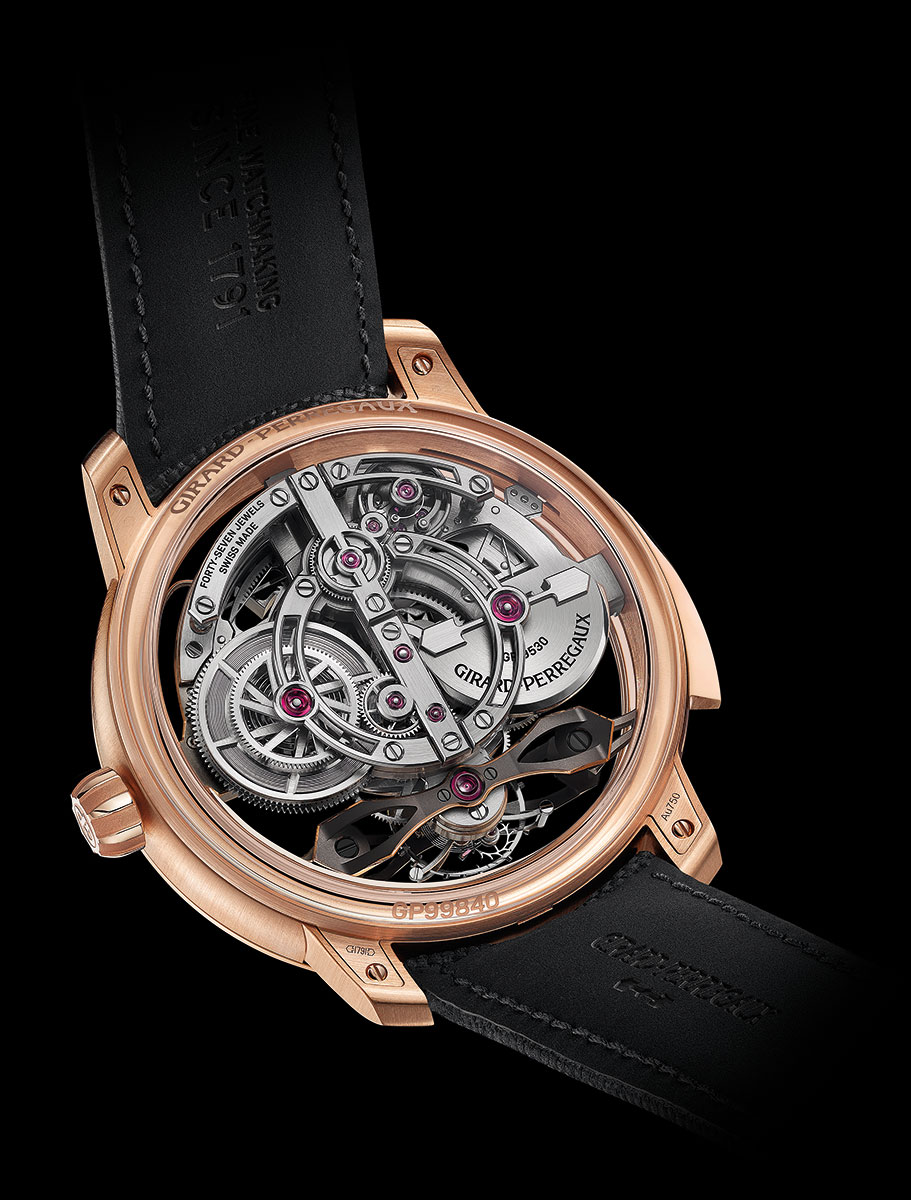
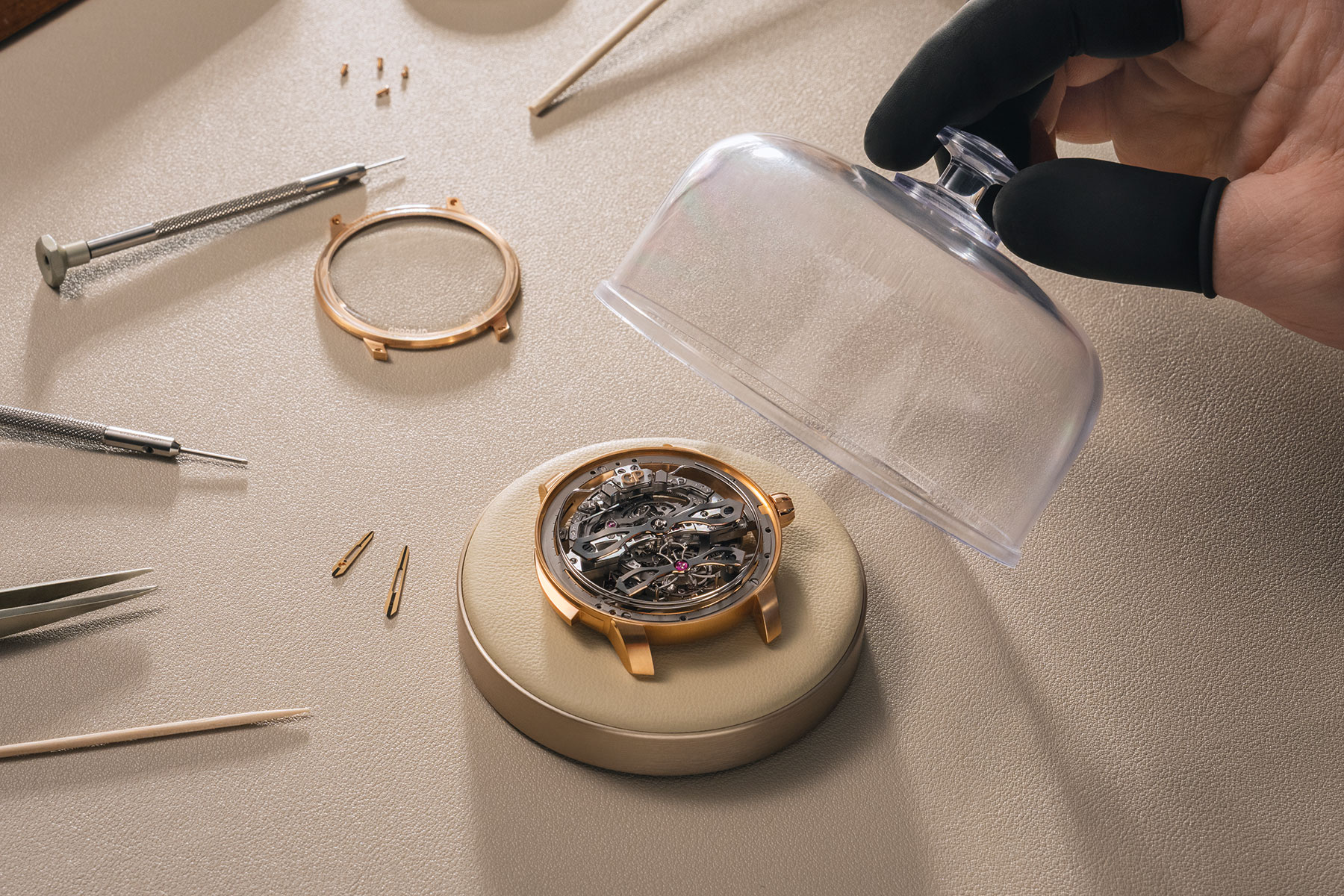
The Calibre GP9530 is remarkable not merely for its component count – 475 parts – but for its extraordinary level of hand-finishing. The movement features 1,340 hand-polished angles, including 295 interior angles, which exceeds conventional haute horlogerie standards. Completing and assembling this movement requires over 440 hours – roughly 11 weeks of dedicated work by a single master watchmaker. Because each watchmaker invests so much of themselves into the piece, every movement is hand-signed on a satin-finished plate with their initials. Jean-Luc Borel, our master watchmaker responsible for this movement, signs his initials, “JLB,” directly onto it.
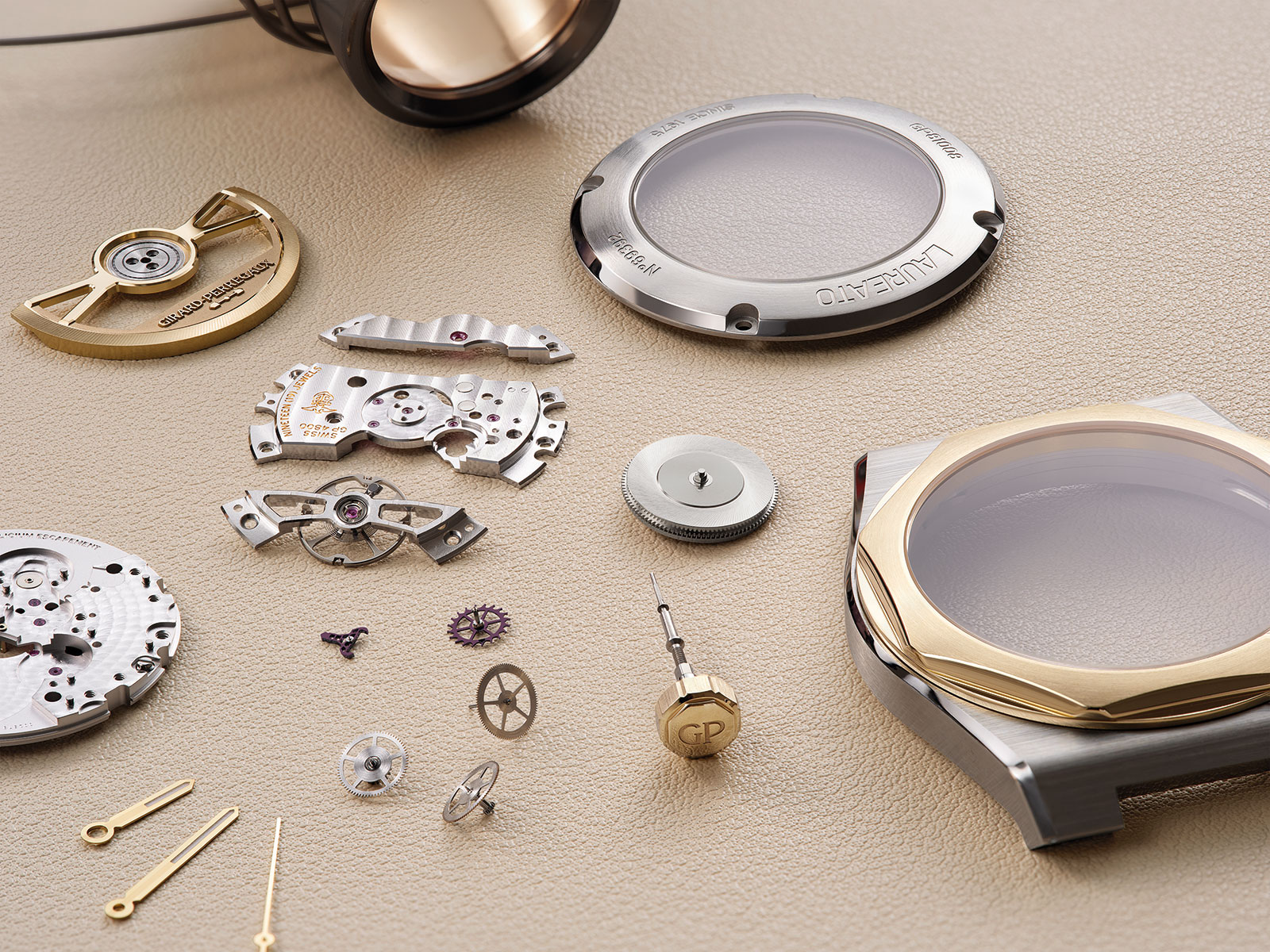
That explains the visual in the press materials (though not visible in our images here). On that note, tell us more about the movement architecture, which is much more beautiful than the words 295 interior angles!
Continuing Constant Girard’s legacy, the architecture reconciles acoustic performance with sculptural beauty. The master watchmakers, movement engineers, and case designers collaborated so that every functional decision serves an aesthetic purpose.
The signature Three Bridges layout has been reinterpreted: Two bridges are positioned on the dial side and one at the back. The hammers and gongs are placed dial-side so acoustic energy isn’t absorbed by the wrist. The hammers themselves mirror the iconic shape of the bridges.
The movement architecture mirrors human anatomy: a central spine flanked by vital organs. On the dial side, the mainspring barrel is visually balanced by a white-gold micro-rotor of identical diameter, creating central vertical symmetry. The dedicated minute repeater barrel is positioned centrally. Functions that could create unwanted acoustic friction – such as the centrifugal governor – are placed on the back, and the micro-rotor is mounted on a jewel rather than ball bearings to minimise extraneous noise. Constant Girard’s historical 19th-century lyre-shaped tourbillon cage completes the composition.
Furthermore, the bridges and mainplate are crafted from titanium. The plate is integrated seamlessly into the case structure.
Jean-Luc Borel has been an active musician since age 14. He has a trained ear and serves as the ultimate arbiter of whether a watch is acoustically ready for release. If he is dissatisfied with the chime, it requires disassembling major portions of the movement for minute acoustic adjustments. Production is strictly capped at eight pieces per year, adhering to a “one watchmaker, one watch” philosophy. We currently have two master watchmakers qualified for this calibre, with the second working under Jean-Luc’s guidance.
Finally, across our two centuries of chiming legacy, this represents our first automatic minute repeater equipped with a micro-rotor.
Why take on the added complexity of making this an automatic rather than a traditional manual-wind repeater?
A micro-rotor does not obstruct the view like a full winding rotor; it integrates flush into the movement architecture. From a practical standpoint, it allows the owner to wear the watch continuously or leave it for a couple of days without losing time or requiring constant manual winding.
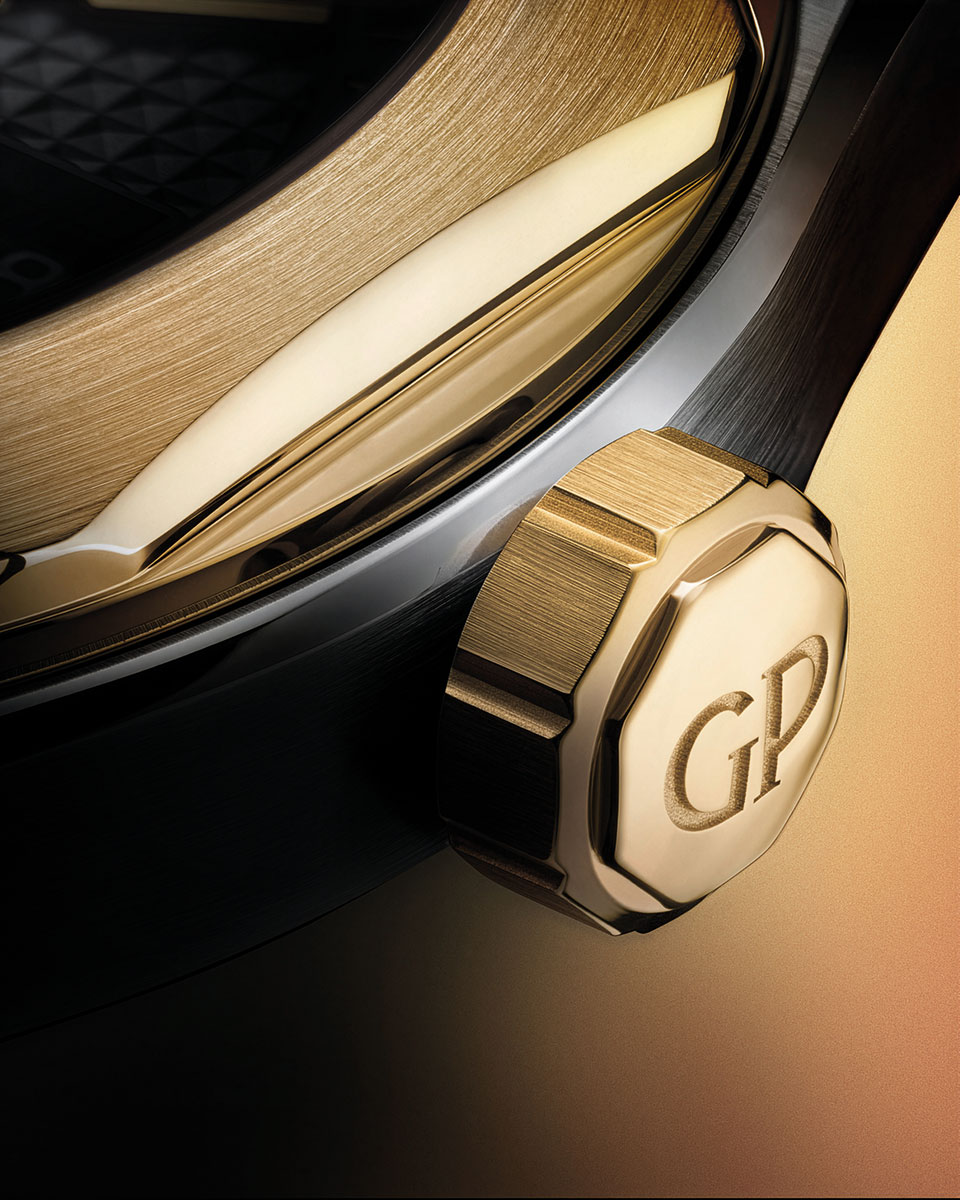
Aesthetically, aligning two circular elements of identical diameter – the barrel and the micro-rotor – creates vertical balance across the central axis. Girard-Perregaux has long innovated with micro-rotors, including patented designs placed beneath the barrel in our Three Bridges calibres.
It is interesting that you didn’t use the terms “openworked” or “skeletonised” in the model name, even though many brands apply those labels liberally.
Open architecture is an intrinsic part of Girard-Perregaux’s design DNA dating back to 1867, so we do not feel the need to label it.
A piece like this cannot be summarised in a soundbite. It begins with visual impact – proportions, symmetry, and architectural depth – and expands as you examine the slate-grey titanium tones paired with the brushed pink-gold case In terms of mechanical complications, there are no limitations on what our manufacture can execute internally – whether tri-axial tourbillons, minute repeaters, or astronomical indications. When our watchmakers and movement engineers convene, the variable is simply the development time required.
Our guiding constraint is ensuring that whatever we build remains faithful to our historical DNA. We wanted to interpret the minute repeater not merely as an acoustic mechanism, but as an expressive, impeccably finished horological sculpture.
For grand complications involving extreme finishing or case engraving, the value delivered to the collector often exceeds standard commercial margins, given the sheer allocation of manufacture resources. How do you frame that commercial proposition?
When you factor in over 440 hours of master watchmaker labour for assembly and finishing alone, this is not a product designed for high commercial margins. We do not design high complications around predetermined marketing price brackets.
A grand complication serves as an ambassador of the manufacture’s internal know-how, craftsmanship, and heritage. Girard-Perregaux does not rely on massive celebrity ambassador campaigns or billboard-driven marketing; our timepieces and the technical mastery within them are our primary statement.
As for the case construction, repeater slides typically introduce vulnerability to dust and moisture. Was 30-metre water resistance a baseline requirement from the start?
The water-resistance engineering originated directly from our case design team. Traditional minute repeater slides create an opening along the case flank, exposing the movement to external elements.
Our team developed a sealing system that prevents any ingress regardless of the slide’s position. While an owner will not swim with a half-million-franc grand complication, the 30-metre rating provides complete everyday peace of mind, ensuring the movement inside remains protected.
For grand complications of this stature, collectors often treat them as delicate statement objects rather than timepieces meant for regular wear.
Which is a shame, because…complications should never become a constraint. With this minute repeater, operation is straightforward: you set the time, let it run, and enjoy it.
That ties back to performance through beauty. While it is an artistic object, it remains a robust, functional wristwatch, rather than something fragile that must be treated as sacred.
Exactly. Beauty is complex to define. You don’t arrive at beauty through a rigid formula; you experience an immediate visceral and emotional response first, and then begin to rationalise it through the details – the symmetry, the balance, the hand-finishing, the microrotor integration.
Despite the watch’s 46mm diameter, collectors are often surprised by the minute repeater’s lightness on the wrist. Between the box sapphire crystals on both sides, the skeletonised architecture, and the floating bridges, the movement appears suspended (as if by magic). The watch is also exceptionally comfortable. Even though it is a high complication, we have activated the slide mechanism hundreds of times during testing and presentations. It is built to be worn and enjoyed.
How does the design philosophy behind Calibre GP9530 run in parallel with the development of something like the GP4800 for the Laureato? They inhabit completely different price brackets, yet both emerge from the same manufacture.
Within the span of six months, this represents our third major allnew movement, with a fourth arriving later this year.
At Girard-Perregaux, everything we produce is haute horlogerie. Haute horlogerie is not defined strictly by complications, tourbillons, or price tags. A three-hand Laureato powered by the new Calibre GP4800 is genuinely haute horlogerie.
It starts with our heritage as an integrated manufacture since 1791 under Jean-François Bautte: designing, developing, decorating, assembling, and regulating movements entirely in-house. It is defined by the level of care and finishing applied not only to the calibre, but to the case, bezel, and integrated bracelet. Whether producing an 18k pink gold dial or a grand complication, our watches are crafted without compromise.
Introducing four distinct calibres in such a short window is an immense technical undertaking.
We do this because movement design is our signature; again, not ambassadors not huge sponsorships. This philosophy also underpins our partnership with Williams Racing in Formula 1. Both maisons possess enduring heritage – Girard-Perregaux’s spanning 235 years, and Williams’ approaching 50 years on the grid as one of the sport’s foundational teams. Williams consider themselves purists in Formula 1; they are there strictly to race and push motorsport engineering forward, not to market energy drinks or sell road cars. Similarly, Girard-Perregaux acts as a pure player in haute horlogerie. Our capital, resources, and dedication are directed squarely at mechanical watchmaking and calibre development.
How do you ensure that uncompromising intentionality is clearly communicated across every segment of the collection, from entry level models to grand complications?
We use the exact same horological language across the entire portfolio. When presenting a three-hand Laureato, the dialogue centres on why and how it was created. The distinction lies in the hours of hand-finishing, material choices, and specific skill tier required, but the underlying standard of manufacture execution remains identical.
Given that market forces and collector hype often define commercial value for iconic steel sports watches, how do you clearly communicate the intrinsic artisanal value of the Laureato?
The industry as a whole must do a better job articulating intrinsic value beyond raw materials and basic functions. For Girard-Perregaux, that value is rooted in independence and authenticity. We are an independent manufacture, not part of a multi-brand luxury conglomerate. We do not share base calibres across sister brands, fit a custom rotor, and rename it. Our movements, cases, and designs are developed entirely inhouse within our own manufacture and design studio. At Girard Perregaux, the effort, engineering, and human hours invested justify the cost, ensuring that every piece delivers authentic substance.
This story was first seen as part of the WOW #86 Autumn 2026 issue.
For more on the latest in luxury watch reads, click here.